
Table of Contents
Islamic cultural diffusion carried ideas, art, and science across continents long before modern travel. Merchants, scholars, and pilgrims moved language, architecture, and technology from Spain to Southeast Asia. That exchange left visible traces in mosques, markets, and manuscript libraries that visitors can still explore today.
Understanding this process helps travelers read the history behind a skyline. A single carved arch or a loanword in a local dialect can reveal centuries of contact. This guide explains how Islamic cultural diffusion worked and where to see its legacy.
For modern visitors, this history is not abstract. It explains why a Spanish courtyard, an Egyptian market, and an Indonesian mosque can feel connected while remaining distinct.
What Islamic Cultural Diffusion Means
Islamic cultural diffusion is the spread of religious ideas, scholarly knowledge, artistic styles, and daily customs across societies connected by trade and pilgrimage. It was rarely a one-way transfer. Local communities adapted what they received, producing hybrid forms in music, food, and architecture. Historians such as those at the Smithsonian Institution describe these routes as a shared vocabulary that still shapes modern life.
The process accelerated between the eighth and sixteenth centuries. Caravans crossed Central Asia, ships crossed the Indian Ocean, and pilgrims traveled to Mecca from every direction. Each journey carried more than goods; it carried books, recipes, and legal ideas. That is why the exchange appears in so many unrelated places.
Scholars often separate intentional transfer from gradual adaptation. Traders spread practical tools, while pilgrims spread rituals. Both forces combined to make the exchange durable.
Five Pathways of Islamic Cultural Diffusion
Five major pathways carried these influences across continents. The table below summarizes their regions, eras, and lasting legacies before the sections that follow explain each route.
| Pathway | Region | Era | Legacy |
|---|---|---|---|
| Overland caravan trade | Central Asia & Middle East | 8th-13th centuries | Spread of paper, astronomy, and textile patterns |
| Scholarly translation centers | Baghdad, Damascus, Cairo | 9th-12th centuries | Preservation of Greek philosophy and medical texts |
| Andalusian cultural exchange | Iberian Peninsula | 10th-15th centuries | Architecture, music, and agricultural innovation |
| Maritime spice routes | Red Sea, Indian Ocean, Southeast Asia | 9th-16th centuries | Diffusion of calligraphy, ceramics, and legal codes |
| Pilgrimage networks | Mecca, Medina, global | 7th century onward | Shared rituals, language, and charitable institutions |
1. Overland Caravan Trade
Trade caravans linked the Mediterranean with the Indian Ocean, moving textiles, spices, and manuscripts. Paper traveled west along these routes and changed how Europe recorded knowledge. According to the Smithsonian Institution, these corridors created a shared vocabulary that still appears in modern languages.
Caravanserais along the route doubled as libraries and meeting places for merchants from different faiths.
2. Scholarly Translation Centers
Scholars in Baghdad translated Greek philosophy into Arabic, fueling a movement that later reached European universities. The House of Wisdom became a hub where astronomy, medicine, and mathematics converged. Damascus and Cairo played similar roles, preserving texts that might otherwise have been lost.
Translators often worked in teams, blending Greek, Persian, and Indian sources into a shared scientific vocabulary.
3. Andalusian Cultural Exchange
In Al-Andalus, Muslim rulers patronized libraries that preserved classical texts, allowing these influences to reach Christian kingdoms. UNESCO notes that Cordoba’s Great Mosque showcases blended architectural styles that inspire designers today. Visitors can still see how Andalusian tile work mingles with local motifs.
Agricultural techniques such as irrigation also traveled with scholars and farmers, changing diets across the peninsula.
4. Maritime Spice Routes
Maritime routes across the Red Sea and the Strait of Malacca spread calligraphy, ceramic techniques, and legal concepts into East Africa and the Malay Archipelago. Port cities such as Kilwa and Malacca became melting pots of tradition. National Geographic reports that these harbors connected faith, commerce, and craft.
Ship captains relied on navigational knowledge shared across the Indian Ocean, a practical form of exchange rarely recorded in books.
5. Pilgrimage Networks
Pilgrimage tied distant communities to Mecca and Medina. Travelers carried rituals, charitable practices, and stories home, and they returned with new ideas about education and law. This constant movement made the exchange a living process rather than a single historical event.
Returning pilgrims funded schools and hospitals, embedding charitable institutions into local life.
What Travelers Can See Today
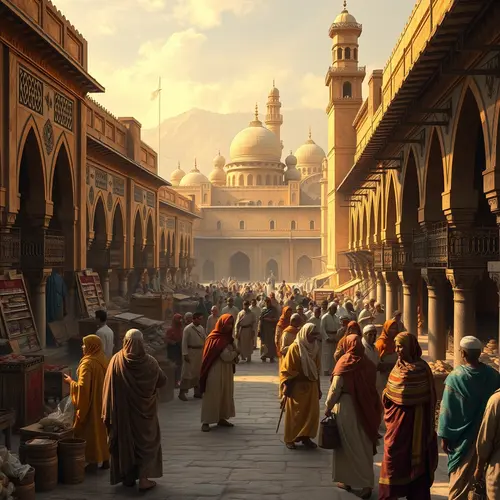
A traveler walking the medina of Fez can observe how Andalusian tile work mingles with Berber motifs. Istanbul’s mosques show Byzantine and Ottoman engineering side by side. In Malacca, Chinese, Malay, and Islamic styles share the same street. These places make centuries of exchange tangible.
Planning a heritage trip is easier with a clear route. Compare Umrah packages if your journey includes Saudi Arabia, and read what Umroh means before you go. Our Islamic heritage tourism section lists more historic sites.
For primary documentation, see the UNESCO World Heritage list, which records many of the monuments described here.
How to Study Islamic Cultural Diffusion
Start with primary sources. Manuscript catalogs in Cairo, Istanbul, and Timbuktu list works that traveled across regions. Compare those records with local architecture and dialects to see how ideas were adapted.
Museums and university collections increasingly digitize these materials. Open access archives let students trace a single manuscript across centuries without leaving home. Comparing these records reveals how Islamic cultural diffusion adapted to local needs.
Why It Still Matters
Islamic cultural diffusion continues today through migration, education, and digital media. Recognizing older patterns helps observers interpret new exchanges more carefully.
Key Takeaways
The main lessons are practical:
- Trade, scholarship, and pilgrimage carried the exchange.
- Al-Andalus, Baghdad, Cairo, and Malacca show clear architectural traces.
- Loanwords and food traditions reveal contact in daily life.
- Manuscript libraries preserve primary evidence for researchers.
- Travelers can follow historic corridors to see layered heritage.
Islamic cultural diffusion shaped languages, buildings, and institutions across three continents. Seeing that legacy in person adds depth to any journey. The pathways above offer a practical starting point for curious travelers and researchers alike.
Frequently Asked Questions
What does Islamic cultural diffusion mean?
It is the spread of religious ideas, scholarly knowledge, art, and customs across societies linked by trade and pilgrimage. Local communities adapted what arrived, creating hybrid forms in music, food, and architecture.
Which regions show the clearest legacy?
Al-Andalus, Baghdad, Cairo, the Swahili coast, and the Malay Archipelago preserve strong traces. Each region blended incoming traditions with local practice, so the results look distinct rather than identical.
Can travelers see examples today?
Yes. Historic mosques, manuscript libraries, markets, and tile work in Fez, Cordoba, Istanbul, and Malacca remain open to visitors. Guided tours often explain how specific features traveled along trade routes.
Driven by my passion as a Muslim who loves religious destinations, I document personal spiritual journeys to learn what travelers truly seek: devotion, comfort, and lasting memories. This vision shapes end-to-end pilgrim support. I have documented 2,312 travel guides here since 2022.

More Stories
American Society of Muslims: Complete Historical Guide
Islam Major Figures: 7 Leaders Who Shaped History
Islamic Cultural Diffusion: 5 Major Pathways