

Table of Contents
Islam is a religion based on principles and rules that are set on every Muslim of the world. However, a Muslim’s gratitude towards Islam, and therefore Allah, is incomplete without the journey to the Holy city of Mecca. This pilgrimage of travelling to Mecca is called the Hajj pilgrimage or the Umrah. Though both the pious pilgrimages mean paying respect in person to the Holy Almighty at the Holy city, there is a difference of time between the two.
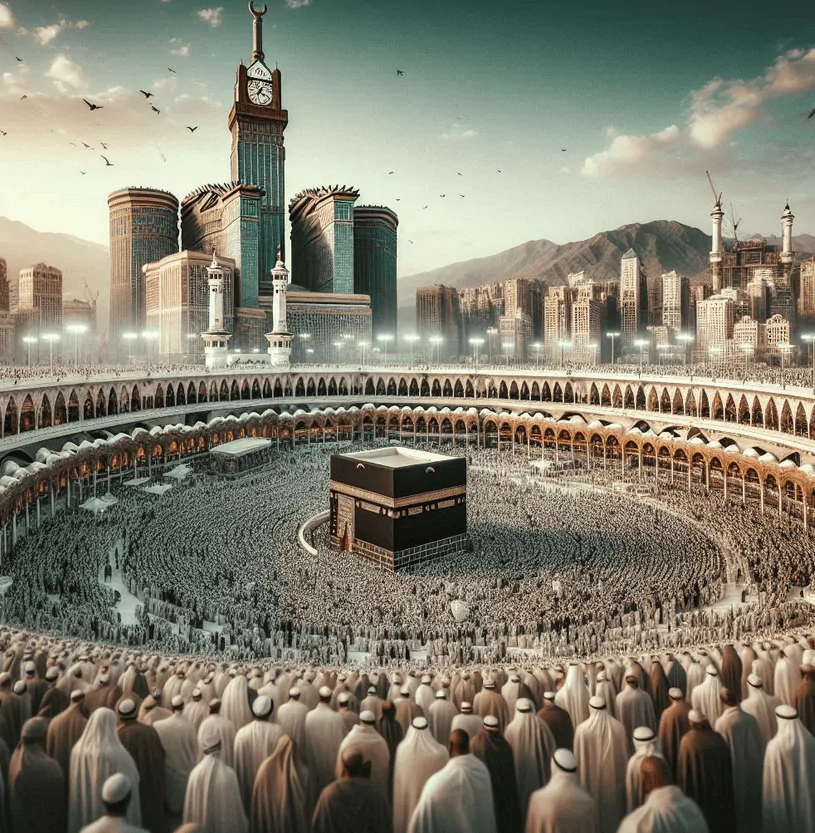
Whereas Umrah may be performed at any time of the year, Hajj has to be completed at least once in a lifetime of a Muslim (only if he is in the condition to afford it). Hajj is obligatory (fard) in a Muslim’s life and both the journeys are to be performed only in the state of Ihram – the state of being clothed in only two clothes that are not sewed together. Hajj is majorly adopted in the 8th, 9th or the tenth month of Dhul-Hijja.
Umrah involves performing Tawaf of K’abah and Saee – running between the holy hillocks that are Marwa and Safa. Tawaf means to make a circuit (7 circuits, precisely) and K’abah is a cubic structure that is constructed with stone and mofar at the holy city of Mecca. The K’afah is covered wth black cloth and is decorated with gold and has the verses of Holy Quran on it.
The K’afah is a very important structure of worship for Muslims all over the world as it is considered as the House of God, aka Bait-ul-lah or the Sacred Mosque, al-Masjid-al-Haram. It is revered so much because K’abah is said to be the first place on Earth that was built to worship only Allah. While offering their Salat (daily prayers), Muslims face in the direction of K’abah irrespective of where in the world they are situated.
Umrah is a shorter pilgrimage but not a substitute of Hajj. However, Umrah may be included in Hajj by including Umrah in Niyat (intention) of a pilgrim. Hajj is a Fard and is the fifth pillar of Islam. A Muslim has to visit Mecca and offer Talbiyyah – continuous chanting of the verse:
“Here am I, O Allah, Here am I;
Here am I, thou hast no associate, here am I;
All praise and bounty are Thine, and Thine the Kingdom;
Thou hast no associate.”
Tawaf has to be performed in Hajj from the 10th day to the 12th day; the days of Hajj are known as Zulhajj. An animal is sacrificed on the 10th Zulhajj and is a ritual in Hajj.
There are certain rules and regulation that are associated with Hajj and Umrah.
Whenever Hajj or Umrah has to be performed by a person, the person should be Muslim and should be sound from mind and health. He or she should be free from debts and compulsorily should be financially sound enough to go on the pilgrimage without putting his dependents at financial risk. A woman may decide to go on Hajj but only with her husband or Mahram – relatives that are close to the woman but whom she cannot marry (son, brother, etc.)
Differences Between Hajj and Umrah
Hajj and Umrah are both pilgrimages to Makkah, but they differ in timing, length and obligation. Hajj is performed in the month of Dhul Hijjah over several days and is obligatory once for those who are able. Umrah can be done at any time of year and is highly recommended but not obligatory. Hajj and Umrah share the ihram, tawaf and sa’i, yet Hajj adds Arafah, Muzdalifah, Mina and the standing that defines the journey.
Preparing With the Right Intention
Preparation for Hajj and Umrah begins with intention. Settle debts, seek forgiveness and learn the rites before you travel. Physical training matters, especially for Hajj, but patience matters more. Hajj and Umrah are acts of worship, not holidays, so build your schedule around prayer rather than shopping.
Common Misconceptions About Hajj and Umrah
Some people think Umrah can replace Hajj, which is not the case for those who are obliged to perform Hajj. Others believe Hajj and Umrah erase all responsibilities, but rights owed to people still must be restored. A qualified teacher can clarify these points before you book.
Understanding Hajj and Umrah also helps families support a pilgrim at home. Agree on communication, manage expectations and avoid adding financial pressure. The journey is easier when the whole household shares the intention.
Many families plan a shorter Umrah first, then save for Hajj. That order can build confidence, but it does not change the obligation for those who are able. If you are comparing the two, read a reliable overview of Hajj and our Umrah guide before setting a date.
Practical preparation includes vaccination, fitness and a realistic budget. Learn the sequence of rites, practise patience in crowds and arrange care for dependants at home. These steps apply to both journeys and reduce anxiety once you arrive.
Speak to a scholar if your circumstances are complicated, such as caring for a dependant or managing debt. Clear guidance protects both your worship and your family.
Write your questions down before you travel and ask someone knowledgeable while you still have time to act.
Allow time to rest before and after the journey, and tell your employer or family what you need. A well-prepared pilgrim is better able to focus on worship and to help others along the way.
Frequently Asked Questions
Is Hajj and Umrah compulsory for every Muslim?
Hajj is obligatory once for adults who are able, while Umrah is recommended but not compulsory in most scholarly opinions.
Can I perform Hajj and Umrah in one trip?
Yes. Many pilgrims combine Hajj and Umrah, but the rituals and timing must be followed carefully, so learn the rules before you travel.
What is the main difference between Hajj and Umrah?
Hajj includes specific days and rites in Dhul Hijjah, while Umrah is shorter and can be performed at any time of year.

Driven by my passion as a Muslim who loves religious destinations, I document personal spiritual journeys to learn what travelers truly seek: devotion, comfort, and lasting memories. This vision shapes end-to-end pilgrim support. I have documented 2,312 travel guides here since 2022.


More Stories
Discover the Beauty of Punta Cana with Reliable Car Rental Services
Exploring the Essence of Umroh Tour Travel: A Journey of Spiritual Fulfillment
How Islamic Books by Dr Muhammad Tahir ul Qadri Could Enlighten You